Urdu qaida for kids: alif bay pay, haroof e tahaji and tracing.
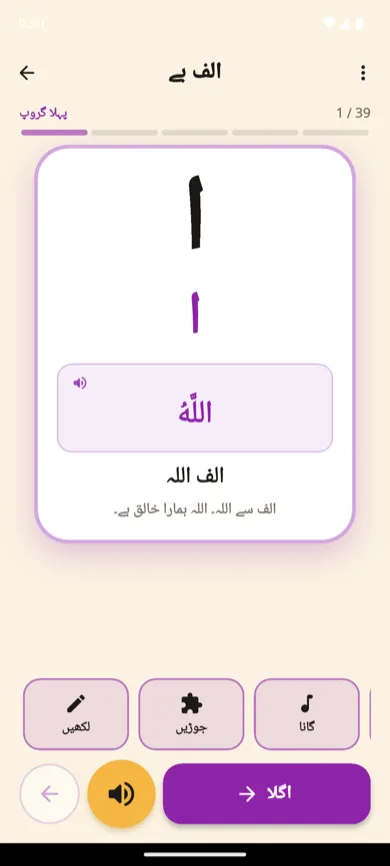
KidSpin is a free Android Urdu qaida app for children aged 3 to 7, with no ads and no login. It teaches all 39 Urdu letters (haroof e tahaji) in qaida order, from alif to bari yay, each with a picture word, an Urdu read-aloud and finger tracing with numbered start dots. The same app has English ABC, counting in English and Urdu, and stories.
By Asad Mahmood, KidSpin’s developer · Updated 19 October 2026
Free learning modules · No ads · No account required. Optional paid Bonus Pack: see pricing.
How many letters does KidSpin teach in the Urdu alphabet?
KidSpin’s Urdu qaida teaches 39 letters in order, from alif (ا) to bari yay (ے). Each letter has a picture word, an Urdu read-aloud and a finger-tracing exercise with numbered start dots, including the dots (nuqte) on letters such as ب، پ and ت. Alphabet charts differ slightly in how they count letters, so follow the order your child’s school uses.
At what age can my child start the Urdu alphabet in KidSpin?
The Urdu letters are shown from age 3, the same as the English ABC. Start with recognising one letter and its picture word; move on to tracing when your child can follow a line with a finger. For a week-by-week plan, read how to teach alif bay pay at home.
From alif bay pay to finger tracing
- Recognise a letter: explore ا، ب، پ and the rest of the Urdu alphabet in sequence.
- Connect it to a picture word: talk about familiar examples such as اَنار، بَطَخ and پَنکھا.
- Trace its shape: follow the on-screen guidance with a finger, including the letter’s dots.
- Hear and discuss the word: read-aloud uses your phone’s Urdu text-to-speech voice, rather than a human recording.
- Switch languages: use English and Urdu explanations as part of your family’s routine.
This is early Urdu alphabet practice. It does not teach Quran recitation, tajweed or a complete reading curriculum.
Try a five-minute Urdu activity at home
- Choose one letter. Open Alif Bay Pay and look at its shape together.
- Say the picture word. Point to the picture and repeat the word yourself. Listen to the phone voice before your child relies on it.
- Trace the letter once or twice. Notice where each dot belongs. Pause if your child loses interest.
- Move to paper. Draw a large letter together with a pencil or crayon.
- Revisit it another day. Short and daily works better than long and weekly. From KidSpin 1.0.5 (available on Google Play since 14 October 2026), a letter earns its sticker only when your child taps the right picture after hearing it, and learned letters come back for a quick review one, three and seven days later.
For writing on paper, print the free alif bay pay tracing worksheets: 39 A4 pages with the same stroke order as the app. For more practice, explore letter tracing for kids or try the free browser tracing activity.
Choose the Urdu learning tool that fits your goal
| Resource | What its listing focuses on | When to consider it |
|---|---|---|
| KidSpin | Urdu letters and tracing, English ABC, counting and Islamic basics | Short bilingual activities in one ad-free app |
| Basic Urdu Qaida for Kids | Urdu alphabet pictures, sounds, writing practice and five alphabet activities | A dedicated Urdu alphabet app; its listing declares ads |
| Madani Qaida Urdu | Quran-reading preparation with word-by-word audio and tajweed | A different goal: Quran recitation rather than Urdu alphabet tracing |
Comparison based on the publishers’ Google Play listings checked 9 October 2026. Features and availability can change.
Learning beyond the Urdu alphabet
Pair a letter with preschool counting and picture activities, or explore namaz pictures and daily duas. Families who prefer to read this guide in Urdu can use بچوں کے لیے اردو ایپ.
For a home routine, read teaching alif bay pay at home. Keep app practice short and support it with everyday conversation and paper-based writing.
Questions parents ask
What does the Urdu qaida module teach?
KidSpin introduces 39 Urdu letters, picture words and finger tracing. It supports early alphabet practice, not a full Urdu reading or handwriting course.
Is the Urdu audio a native human recording?
No. KidSpin reads words using the phone’s Urdu text-to-speech voice. Pronunciation and quality vary by device and installed voice. Listen with your child and model unfamiliar words yourself.
Can children practise Urdu writing?
Yes. Children can trace Urdu letter shapes with a finger, using the tracing guides. Screen tracing is introductory practice; use paper and a pencil as well for handwriting.
Does the Urdu app work offline?
Letter cards and activities are bundled with the app. Spoken Urdu needs a compatible installed voice, which may require an initial download. Purchases, licence checks and optional online services can need internet.
Is KidSpin free?
Yes. All 39 Urdu letters, tracing, English ABC, counting, namaz, kalmas and duas are free, with no ads. An optional Bonus Pack adds ten more modules for $2.99 once on Google Play (Rs 299 in Pakistan). There is no subscription. See pricing.
Bachon ko Urdu haroof kaise sikhayen?
Roz ek harf. Pick one letter a day, say its name and a picture word together (bay se batakh), trace it with a finger in the app, then write it big on paper with a crayon. Go back to the same letter the next day if it was hard. Keep it to five or ten minutes so it stays fun.
Are there free Urdu tracing worksheets to print?
Yes. The printable tracing worksheets page has a free 39-page alif bay pay pack and an Urdu ginti 1 to 20 sheet, as A4 PDFs with no sign-up. They follow the same stroke order as KidSpin's tracing game: right to left, nuqte last.
Start with alif, one picture and a little tracing.
Start with the free modules on Android. No ads or child account.
GET IT ONGoogle Play