
1. Start with the letters in their name
Children learn the letters of their own name earlier and better than other letters, especially the first letter (Treiman and Broderick, 1998). So if your child is Zara, start with Z and A, not with A, B, C. Write their name on the fridge, point to each letter and say it together.
2. Teach the name and the sound together
Say it as one sentence: "This is B. B says /b/. B for ball." A meta-analysis of 60 studies found that teaching letter names and sounds together gave the strongest results (Piasta and Wagner, 2010). Keep the sound short: /b/, not "buh".
3. Two or three letters a week is plenty
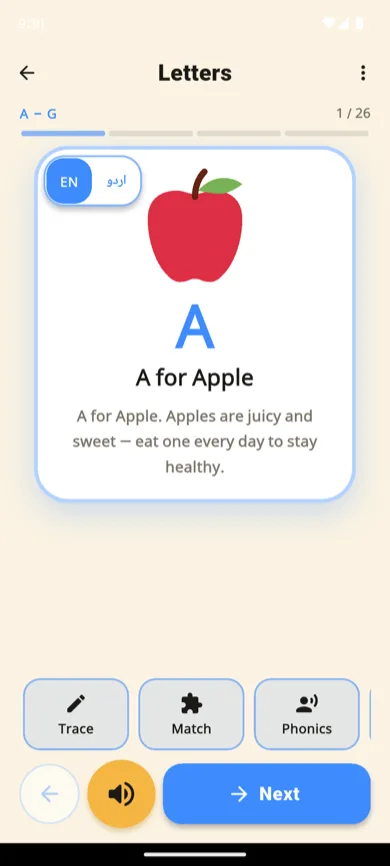
Pick two or three letters, and use them every day that week. A new letter only comes in when the old ones are easy. This is how KidSpin's daily path works too: the next letter unlocks only after the current one is learned.
4. The 10-minute routine
- See and hear (2 minutes). Show the letter, say name and sound, show one picture word.
- Find it (2 minutes). Hunt for the letter in a book, on a cereal box or on a car number plate.
- Trace it (3 minutes). Finger on a big letter, in the right order: start at the top, follow the arrows. Sand, salt on a tray or a tracing app all work.
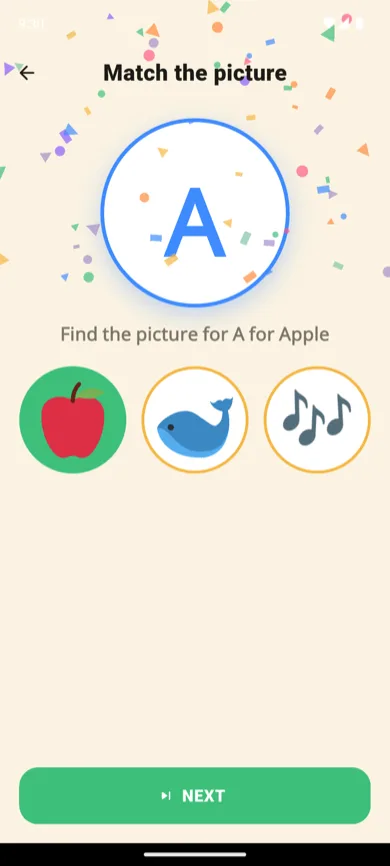
- Play with it (3 minutes). "I spy something starting with /b/", or a matching game.
Stop while your child is still enjoying it. Tomorrow, repeat with the same letters.
5. Trace before you write
Three-year-olds rarely have the hand strength for a pencil. Tracing with a finger teaches the path of each letter first: where to start, which way to go. KidSpin's tracing game uses numbered start dots and arrows, and you can try a few letters free in the browser tracing game.
Then move to paper. A 2012 brain-imaging study (James and Engelhardt) found that preschoolers who printed letters freehand showed more activity in reading areas of the brain than those who typed or traced them. So tracing is the first step; writing with a crayon is the goal.
6. Start with capitals, straight lines first
L, T, E, F, H and I are made of straight lines and are the easiest to form. Then letters with curves: O, C, S. Leave the tricky diagonals (K, M, W) for later. Small letters come after most capitals are known.
What's normal at each age?
| Age | Typical |
|---|---|
| 3 | Sings the ABC song, knows a few letters (often from their name), enjoys finger tracing |
| 4 | Knows more capitals and some sounds, may copy simple letters with a crayon |
| 5 | Names some letters when you point to them (CDC milestone), starts writing their name |
| 6-7 | Knows all letters and most sounds, blends simple words (c-a-t) |
Children vary a lot. If your child is 5 and shows no interest in letters, or you're worried about speech or hearing, talk to your paediatrician or health visitor.
Common mistakes
- Drilling A to Z in order. The order of the song isn't the order of learning. Start with their name.
- Long sessions. Ten happy minutes beat forty tearful ones.
- Correcting every wobble. Praise where they started and which way they went; neatness comes later.
- Apps that reward with ads or coins. The reward becomes the point. Choose an app with no ads and short sessions.
Sources
- Treiman, R. and Broderick, V. (1998). What's in a name: children's knowledge about the letters in their own names. Journal of Experimental Child Psychology, 70(2).
- Piasta, S. B. and Wagner, R. K. (2010). Developing early literacy skills: a meta-analysis of alphabet learning and instruction. Reading Research Quarterly, 45(1).
- James, K. H. and Engelhardt, L. (2012). The effects of handwriting experience on functional brain development in pre-literate children. Trends in Neuroscience and Education, 1(1).
- CDC, "Learn the Signs. Act Early." milestone checklists (2022 update): cdc.gov/ncbddd/actearly/milestones
Questions parents ask
How many letters should a 3 year old know?
There is no fixed number. Many 3-year-olds recognise a handful of letters, often the ones in their own name. The CDC's milestone checklist lists "names some letters when you point to them" at age 5, so a 3-year-old who knows only a few is on track.
Should I teach letter names or letter sounds first?
Teach both together: "This is B, it says /b/, like ball." A 2010 meta-analysis by Piasta and Wagner found that instruction combining letter names and sounds produced the strongest gains in letter-sound knowledge.
Should I teach capital or small letters first?
Most early-years programmes start with capitals because they are easier to tell apart and to form with straight lines. Introduce small letters once your child knows most capitals, starting with those that look like their capital (c, o, s, v, w).
When can a child start writing letters?
Finger tracing works from about 3. Most children can hold a crayon well enough to copy simple letters such as L, T and O between 4 and 5. Don't force pencil grip before hand strength is there.
Is an app enough to teach the alphabet?
No app is enough on its own. Use one for short, guided practice, and add talk, books and paper: point out letters on signs, read alphabet books together, and let them write with a crayon.
